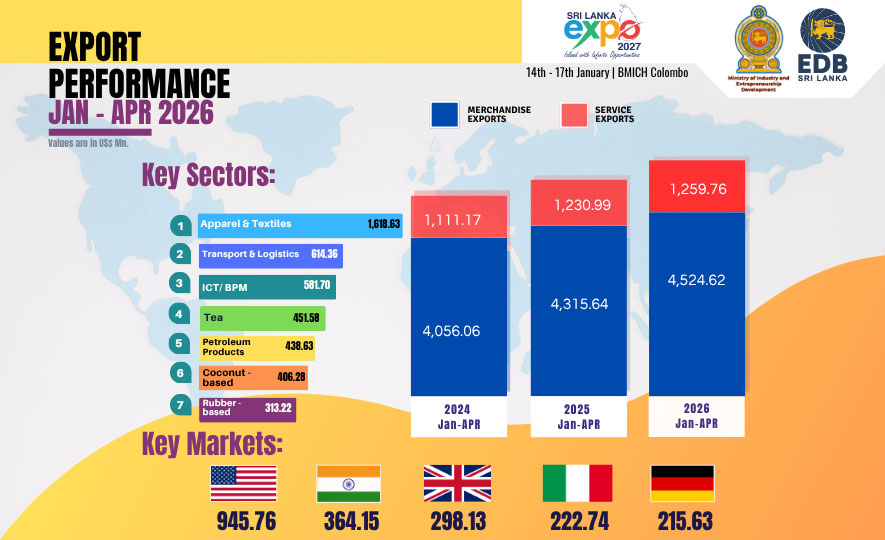
Sri Lanka’s export industry has demonstrated remarkable resilience in the first four months of 2026, surpassing US$ 5.7 billion in total export earnings despite challenging global economic conditions. According to provisional data from Sri Lanka Customs, combined merchandise and services exports reached US$ 1,380.93 million in April 2026, reflecting a 6% year-on-year growth compared to April 2025.
Strong Merchandise and Services Performance
Merchandise exports in April rose by 9.87% to US$ 1,063.77 million, while services exports contributed US$ 317.16 million, underscoring the growing importance of Sri Lanka’s knowledge-based economy. On a cumulative basis, total exports between January and April 2026 amounted to US$ 5,784.38 million, marking a 4.3% increase over the same period in 2025.
Chairman and CEO of the Export Development Board (EDB), Mangala Wijesinghe, emphasized that this performance highlights the stability of Sri Lanka’s external sector. He noted that ongoing export promotion initiatives, market diversification, and strategic measures under the National Export Development Plan are expected to further strengthen growth momentum throughout 2026.
Sectoral Highlights – Positive Growth Drivers
Several key sectors recorded robust growth in April 2026:
- Coconut-based products surged by 23.49%, with strong gains across kernel, fibre, and shell categories. Activated Carbon exports alone rose by 58.32%, reaching US$ 20.55 million.
- Rubber and rubber-based products increased by 5.23%, driven by industrial and surgical gloves, which grew by 22.95%.
- Food & Beverages exports expanded by 45.17%, with processed foods showing an exceptional 145.81% growth, reflecting rising global demand.
- Electrical and electronic components recorded a 41.51% increase, supported by strong growth in insulated wires, switches, and transformers.
- Spices and essential oils rose by 6.26%, with cinnamon exports up by 58.06%.
- Seafood exports grew by 13.07%, reaching US$ 30.19 million, driven by frozen fish shipments.
- Diamonds, gems, and jewellery increased by 6.26%, while ICT/BPM services achieved steady growth at US$ 146.09 million.
These results highlight Sri Lanka’s success in diversifying its export portfolio and adding value across multiple industries.
Sectors Facing Declines
Despite overall growth, some traditional export sectors faced challenges:
- Apparel & Textiles, Sri Lanka’s largest export category, declined by 4.88% in April and 7.4% cumulatively (US$ 1,618.63 million). Reduced demand in the United States, European Union, and United Kingdom contributed to this downturn.
- Tea exports fell by 6.82% in April and 5.58% cumulatively, with bulk tea and packet tea earnings contracting due to weakened demand in Middle Eastern markets such as Iraq, Libya, and the UAE.
- Spices and essential oils recorded a 3.42% decline over the four-month period, largely due to a sharp 48.16% drop in pepper exports.
- Ornamental fish exports decreased by 21.54%, reflecting softer demand in niche markets.
Regional and Market Trends
Sri Lanka’s export performance varied across global markets:
- The United States, accounting for 22% of total exports, showed a modest 3.15% increase in April, but cumulative exports fell by 2.09%.
- India strengthened its position as the second-largest export destination, with cumulative exports rising by 8.9% to US$ 364.15 million.
- Pakistan recorded a strong 37.75% increase in cumulative exports, driven by rubber gloves, textiles, and coconut products.
- Conversely, exports to the United Kingdom declined by 7.96% cumulatively, while the UAE saw a sharp 16.24% drop, impacted by geopolitical tensions affecting trade flows in the Gulf region.
Outlook for 2026
The first four months of 2026 reflect a steady recovery trajectory for Sri Lanka’s economy, driven by both merchandise and services exports. The expansion of ICT/BPM, financial services, and logistics highlights the growing role of the services sector in diversifying the country’s export base and generating high-value employment.
Meanwhile, the strong performance of coconut-based products, processed foods, seafood, and electrical components demonstrates Sri Lanka’s ability to leverage value addition and innovation to meet global demand. However, the decline in apparel and tea exports underscores the need for market diversification and product innovation to sustain long-term growth.
Sri Lanka’s export sector has proven resilient in the face of global economic challenges, achieving US$ 5.78 billion in earnings during January–April 2026. With continued focus on diversification, value addition, and strategic promotion under the National Export Development Plan, the country is well-positioned to strengthen its external sector and achieve its export targets for 2026.